Introduction
As the volume of user-generated content on the internet continues to grow exponentially, artificial intelligence (AI) has become a critical tool for online content moderation. Social media platforms, forums, and digital marketplaces face the challenge of maintaining safe and compliant online environments while managing billions of posts, comments, images, and videos daily. AI offers scalable solutions for identifying harmful, inappropriate, or illegal content, complementing human moderators and helping platforms enforce community standards efficiently. This role is increasingly important in a digital ecosystem shaped by global communication, diverse audiences, and rapid content dissemination.
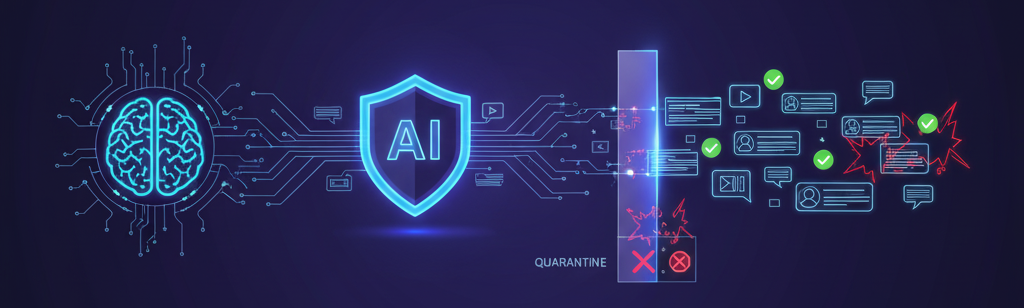
The Need for AI in Content Moderation
Traditional content moderation relied heavily on human review, which is often time-consuming, expensive, and inconsistent. The sheer scale of modern platforms makes it impossible to manually screen all content in real time. Furthermore, harmful content—including hate speech, harassment, misinformation, extremist material, and graphic violence—can spread quickly, causing reputational damage, legal liabilities, and societal harm.
AI addresses these challenges by enabling platforms to automate detection, flagging, and removal of problematic content, ensuring timely intervention and compliance with regulatory frameworks. Machine learning models can continuously improve their understanding of harmful patterns, adapting to evolving language, cultural context, and emerging threats.
Key AI Techniques in Content Moderation
AI-driven content moderation employs a combination of natural language processing (NLP), computer vision, and predictive analytics:
Text Analysis: NLP algorithms detect offensive language, harassment, hate speech, and misinformation in posts and comments. Sentiment analysis and contextual understanding help differentiate between casual language, satire, and genuinely harmful content.
Image and Video Analysis: Computer vision identifies inappropriate visuals, including graphic violence, nudity, or harmful symbols. AI can also detect subtle manipulations, deepfakes, or copyrighted material, enhancing content compliance.
Behavioral Pattern Recognition: Predictive analytics track user behavior to identify potential violations before content is widely disseminated. AI systems can flag coordinated spam, bot activity, or harmful trends proactively.
Human-AI Collaboration
While AI is powerful, human oversight remains essential. AI models may misinterpret context, humor, or cultural nuances, leading to false positives or negatives. Human moderators validate AI decisions, review flagged content, and provide feedback to improve algorithmic accuracy.
This collaborative approach allows platforms to balance efficiency with fairness. AI handles high-volume, repetitive tasks, while human experts ensure nuanced judgment, ethical considerations, and contextual understanding.
Challenges and Limitations
AI-powered content moderation faces several technical and ethical challenges:
Bias and Impartiality: Algorithms trained on biased datasets may disproportionately flag content from certain communities or languages, raising concerns about discrimination and censorship.
Context Understanding: AI struggles with sarcasm, slang, idioms, and cultural context, which can result in inaccurate moderation.
Evasion Tactics: Users often attempt to circumvent moderation through coded language, memes, or encrypted communication, requiring AI models to continually adapt.
Transparency and Accountability: Platforms must explain moderation decisions, especially when content is removed, to maintain the trust of users and regulators.
Regulatory and Legal Implications
Governments around the world are introducing regulations to hold platforms accountable for harmful content. Laws such as the European Union’s Digital Services Act (DSA) and proposed AI regulations emphasize transparency, accuracy, and timely intervention. AI systems help platforms meet these obligations by enabling rapid detection, reporting, and auditing of content moderation processes.
Regulatory compliance also involves protecting user privacy and ensuring the ethical use of data. AI models must be trained responsibly, with special attention to data security, anonymization, and consent.
The Future of AI in Content Moderation
The role of AI in content moderation is expected to expand with advances in deep learning, multimodal AI, and real-time analytics. Future systems will integrate text, audio, video, and behavioral data to provide more accurate and contextualized moderation. AI will also enable predictive moderation, identifying potentially harmful content before it spreads widely.
Collaboration between AI developers, social media platforms, regulatory bodies, and civil society will be critical to address ethical concerns, improve fairness, and ensure transparency. Improved explainability, continuous auditing, and human-involved frameworks will help build trust and accountability.
Conclusion
Artificial intelligence plays a critical role in online content moderation, providing scalable, efficient, and adaptable solutions to manage the immense volume of user-generated content. By combining natural language processing (NLP), computer vision, and behavioral analytics, AI helps identify harmful content, enforce community standards, and maintain regulatory compliance.
Despite its effectiveness, AI cannot fully replace human judgment. Human-AI collaboration ensures that moderation is contextually fair and ethically sound. As technology evolves, AI will remain a fundamental pillar of safe and responsible online environments, enabling platforms to protect users, maintain trust, and navigate the complex digital landscape.