Introduction
The arrival of 5G technology represents a significant milestone in the evolution of telecommunications, offering unprecedented speed, low latency, and massive connectivity. Unlike previous generations of mobile networks, 5G is not limited to faster internet; it is a transformative catalyst for digital innovation, automation, and new business models. By driving real-time data processing, the expansion of the Internet of Things (IoT), and immersive technologies, 5G is transforming industries, improving operational efficiency, and creating new opportunities for businesses worldwide.
The 5G Technological Leap
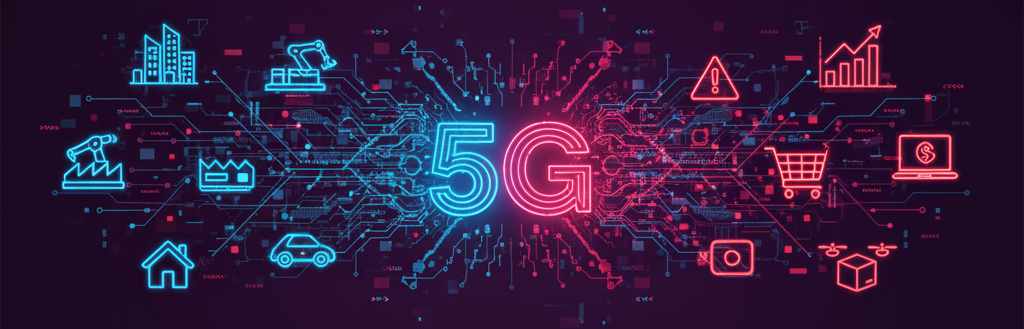
5G networks offer enhanced mobile broadband, ultra-reliable, low-latency communications, and massive machine-to-machine communication, enabling applications that were previously impractical or impossible. Data transfer speeds of up to 10 Gbps, latencies as low as 1 millisecond, and the ability to connect millions of devices per square kilometer make 5G the foundation for next-generation services. This technological leap is driving IoT ecosystems, autonomous systems, smart cities, augmented reality (AR), virtual reality (VR), and real-time analytics. Businesses can leverage these capabilities to optimize their operations, improve customer experience, and innovate products and services.
Driving Digital Transformation Across Industries
5G is a key driver of digital transformation across industries. In manufacturing, it enables smart factories with connected machinery, predictive maintenance, and real-time production monitoring. In healthcare, 5G facilitates telemedicine, remote surgery, and wearable health monitoring devices, providing timely and efficient patient care even in remote locations.
Retailers are leveraging 5G for augmented reality shopping experiences, interactive marketing, and real-time inventory management. The transportation and logistics industries are using 5G for fleet management, autonomous vehicles, and intelligent traffic systems, improving efficiency and safety.
Business Opportunities Generated by 5G
The deployment of 5G networks opens up new business opportunities in multiple areas:
IoT and Smart Devices: Companies can develop connected devices and systems that communicate seamlessly, enabling automation and data-driven decision-making.
Content and Multimedia: High-speed streaming, cloud gaming, and immersive AR/VR experiences generate new revenue streams for content providers and technology companies.
Industrial Innovation: Smart factories, robotics, and automated supply chains reduce operating costs and improve productivity.
Telemedicine and Remote Services: Healthcare professionals can expand their service offerings, including remote diagnostics, surgery, and continuous monitoring.
Urban Development: Smart city initiatives use 5G to more efficiently manage traffic, energy, public safety, and environmental monitoring.
Impact on Business Strategy
Organizations adopting 5G must rethink their business strategies, operating models, and IT infrastructure. Real-time data processing and low-latency communication enable agile decision-making, predictive analytics, and a better customer experience. Companies that integrate 5G into their operations gain a competitive advantage by improving efficiency, responsiveness, and innovation capacity.
Furthermore, 5G fosters partnerships between telecommunications providers, technology companies, and enterprises, fostering ecosystems that accelerate innovation and the market entry of new products and services.
Challenges in 5G Adoption
Despite its potential, 5G adoption faces challenges. Infrastructure deployment requires substantial investment, especially for dense urban coverage and rural connectivity. Spectrum allocation, regulatory compliance, and cybersecurity risks are additional considerations for enterprises and service providers.
Interoperability between existing 4G networks and emerging 5G systems must be carefully managed to ensure service continuity. Enterprises also face challenges in preparing their workforce, as employees require new skills to take advantage of advanced connectivity and IoT-based processes.
Future Trends and Innovations
The full potential of 5G is expected to be realized through its convergence with artificial intelligence, edge computing, and cloud technologies. Edge computing, enabled by 5G, allows data to be processed closer to the source, reducing latency and facilitating real-time decision-making for critical applications. AI-based analytics can leverage massive streams of data from connected devices to optimize operations, predict demand, and personalize customer experiences. Furthermore, 5G facilitates the growth of immersive technologies such as augmented reality (AR), virtual reality (VR), and mixed reality (MR), opening up new opportunities for training, entertainment, marketing, and collaboration. As network coverage expands and technology matures, businesses can innovate with entirely new services and operating models that were previously unviable.
Social and Economic Implications
Beyond the business realm, 5G has social and economic implications. Improved connectivity fosters digital inclusion, providing high-speed internet access to remote and underserved communities. It also fosters entrepreneurship, allowing startups to develop innovative applications and services with lower barriers to entry.
Economically, 5G drives productivity gains across all sectors, stimulates investment in technological infrastructure, and promotes the growth of the digital economy. Governments and private sector stakeholders recognize 5G as a strategic asset that can enhance national competitiveness and technological leadership.
Conclusion
5G technology is a transformative force driving digital transformation and creating new business opportunities across all sectors. Its high-speed connectivity, low latency, and massive device capacity enable businesses to innovate, optimize their operations, and deliver enhanced customer experiences.
While challenges remain in deployment, cybersecurity, and workforce adaptation, strategic adoption of 5G positions businesses to effectively leverage IoT, AI, edge computing, and immersive technologies. As 5G networks expand globally, they will continue to transform industries, drive innovation, and fuel economic growth, ushering in a new era of connectivity and opportunity in the digital landscape.