Introduction
Vanguard, one of the world’s largest asset managers, maintains a particularly bullish stance on U.S. corporate bonds, even in the face of trade policy and tariff risks. The firm acknowledges that while high valuations and geopolitical challenges make understanding the credit market difficult, the fundamentals underpinning investment-grade corporate debt remain strong. With expectations of monetary easing from the Federal Reserve and the relative strength of corporate balance sheets, Vanguard believes the risk/return profile in the corporate bond market continues to offer value. This article examines Vanguard’s rationale, the challenges posed by tariffs, how they assess credit risk, and what the implications might be for investors.
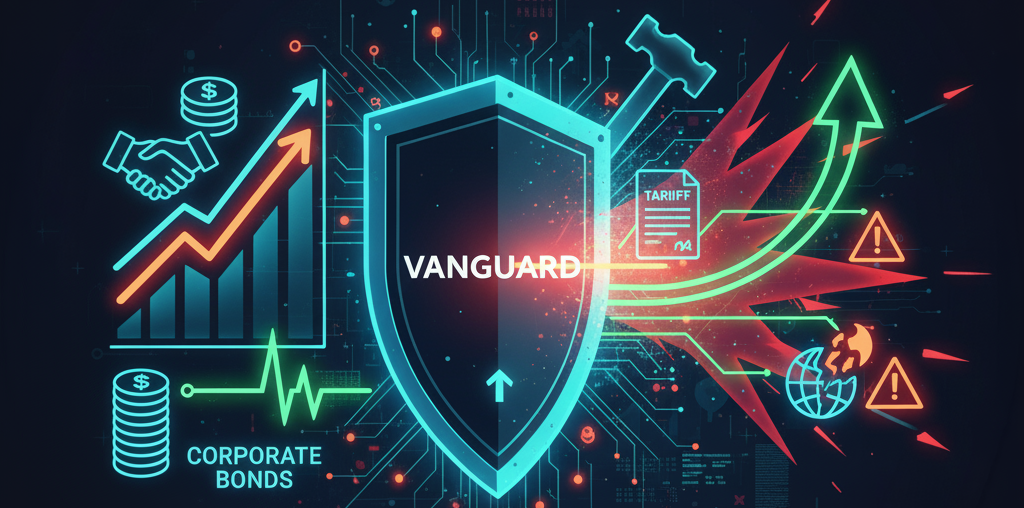
The Basis for Vanguard’s Optimism
Vanguard’s optimism rests on several pillars. First, investment-grade corporate credit spreads—the extra yield these bonds offer over U.S. Treasury bonds—have narrowed to around 74 basis points, their lowest level since 1998. Investing.com+1 A tighter spread suggests market confidence in credit fundamentals. Sara Devereux, Vanguard’s global head of fixed income, describes credit valuations as “elevated, but justified.” Y94+1
Second, Vanguard highlights the strength of corporate and consumer balance sheets, which help companies withstand external shocks such as increased tariffs or inflationary pressures. In its Q2 2025 fixed income analysis, it noted that while changes in tariff policy increase risk, underlying fundamentals remain strong. corporate.vanguard.com+1
Third, expectations of falling interest rates are favorable. Vanguard expects that potential interest rate cuts by the Federal Reserve could improve corporate borrowing conditions, reduce financing costs, and make corporate bonds more attractive relative to other assets. MarketScreener+1
Taxied together, these factors form the basis of Vanguard’s optimistic outlook: tight spreads, strong balance sheets, and a favorable interest rate environment.
Tariff Risks and Vanguard’s Outlook
Despite the optimism, Vanguard acknowledges that tariffs remain a significant risk. It estimates that only about one-third of the economic impact of previous U.S. tariff measures has been absorbed, with further impacts expected through the remainder of 2025 and into 2026. Investing.com+1
Tariffs can increase corporate costs by raising input prices, reducing margins, disrupting supply chains, and causing inflation. These exposures are uneven: companies that rely heavily on international trade or have tight margins are more vulnerable. Vanguard’s analysis underscores the need for selectivity: choosing issuers with greater earnings stability and less exposure to market fluctuations. corporate.vanguard.com
Indeed, tariff risk adds a caveat to optimism: while the overall corporate bond market appears supportive, underlying vulnerabilities warrant due diligence on the part of issuers. Therefore, Vanguard is optimistic, but not complacent.
Valuation, Yields, and Portfolio Strategy
A key tension, according to Vanguard, is that while yields are attractive compared to other fixed-income segments, valuation metrics are high. With credit spreads near historic lows, Vanguard acknowledges that there are fewer margins of safety than in past decades. (The Economic Times+1)
However, total return (which includes the spread plus the yield of the underlying Treasury bond) remains attractive, especially in a higher interest rate environment. For investors seeking income and credit exposure, corporate bonds are considered one of the most attractive fixed-income opportunities. Vanguard’s strategy emphasizes overweighting higher-quality credit, prioritizing mid-term maturities, and being selective in sectors sensitive to tariffs or economic slowdowns. (corporate.vanguard.com+1)
It is important to note that while yield is attractive, caution should not be neglected. Vanguard warns that a recession or a more severe trade crisis could significantly widen credit spreads and impact returns.
Implications for Investors
For individual and institutional investors, Vanguard’s stance offers several practical implications:
Consider credit exposure: Given its optimistic outlook, investors might consider increasing or maintaining their exposure to investment-grade corporate bonds, rather than avoiding credit altogether.
Maintain issuer discipline: Due to the presence of tariff and trade risks, it is crucial to seek out companies with strong fundamentals, diversified supply chains, and limited exposure to trade disruptions.
Pay attention to spread margins: With narrow spreads, the potential for them to widen means that overall returns could depend more on yield than on narrowing. Vulnerable sectors could underperform.
The interest rate environment is important: If the Federal Reserve cuts rates, corporate bonds could benefit from lower Treasury yields and narrower spreads. However, if inflation or trade pressures persist, rate cuts could be delayed, creating risks.
Diversification and risk management: Given that valuations are already high, it is prudent to maintain a diversified fixed-income portfolio (across different sectors, ratings, and durations) and be prepared for adverse scenarios.
Conclusion
Vanguard’s decision to maintain an optimistic outlook on U.S. corporate bonds—despite persistent tariff risks—is based on strong credit fundamentals, attractive yields, and the expectation of more accommodative monetary policy going forward. While they acknowledge the potential for trade policy to affect growth and corporate margins, they believe the market has already priced in a significant portion of that risk and that the remaining outlook supports credit exposure.
For investors, this means that corporate bonds are not simply a default safe haven in fixed income, but a well-thought-out strategic allocation in the current environment, albeit one that requires careful issuer selection and a deep understanding of macroeconomic risks. The lesson: optimism doesn’t mean ignoring risks, but rather balancing them intelligently. As trade policy and inflation evolve, staying on top of how these forces impact companies will be crucial for fixed-income investors.